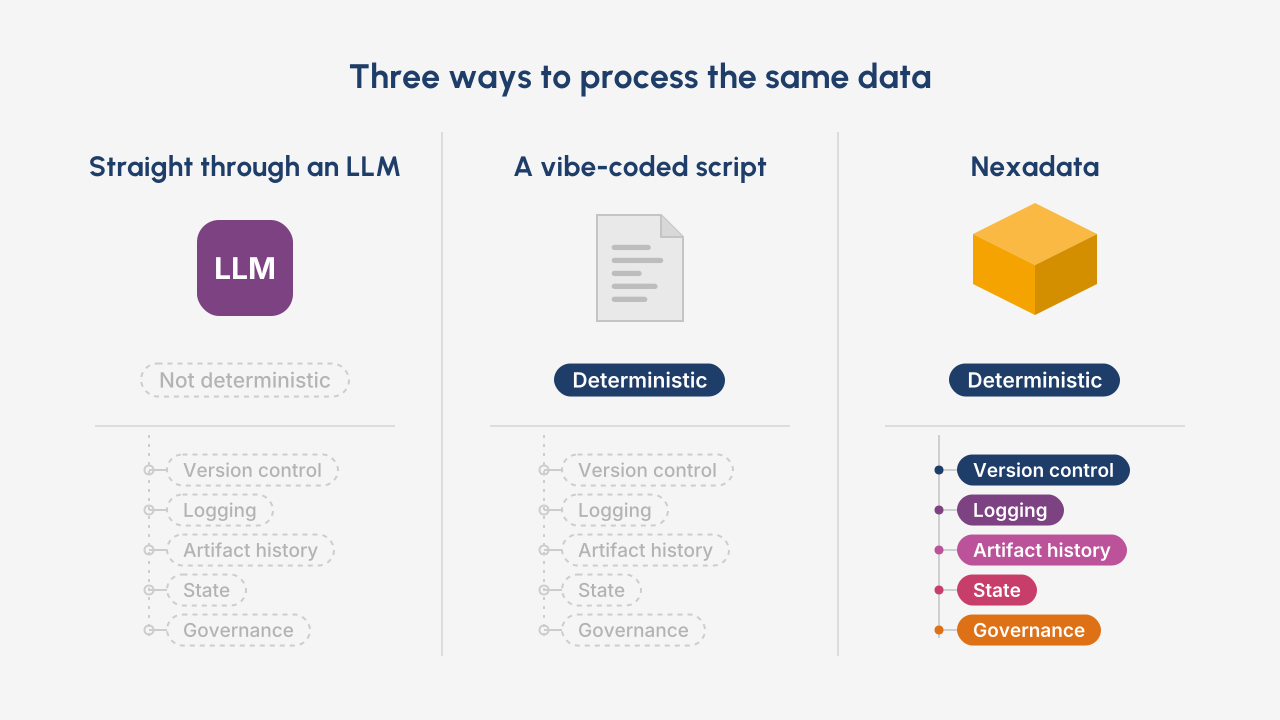
A lot of data integration now leans on vibe coding, or on handing the job straight to an LLM. Both genuinely work, and both are easy to start with. You describe what you want, and the data arrives in the shape your planning and analytics tools need.
So when someone who runs IT for a large enterprise told me what makes Nexadata hard to replicate, I expected the answer to be about the copilots. It was not.
What makes it hard to replicate, she said, is not the AI. It is the unglamorous infrastructure around it. Version control. Logging. Artifact history. State. Security. Governance. The parts nobody demos. The interesting question is not whether a model can meet a data integration requirement. It is whether you can tell, a year later, what ran, what changed, and who approved it.
Generating a pipeline is the easy part
Getting to a working pipeline once is not where the difficulty lives.
The difficulty starts on run two, and it compounds by run one thousand. Who changed this, and when. Which version produced the numbers someone is questioning three months later. What state a workflow was in when it failed halfway through. Who is allowed to change it, and what the record looks like after they do.
That is the distance between a one-time pipeline and a process you can run a thousand times and trust every time. A pipeline is an artifact. A process is a system with a memory. The second one takes years to build, and you tend to notice it only when it is missing.
Capable models make this matter more, not less
The instinct runs the other way. If the model writes the pipeline, why keep the machinery around it?
Because an agent acting on your data at speed makes the record of what it did more valuable, not less. More change per week raises the value of knowing exactly what changed, what ran, and what came out. Governance is not the tax you pay for moving slowly. It is the thing that lets you move quickly without losing the thread.
You can have both
None of this is an argument for giving up the on-ramp. It is an argument for not having to choose.
Our MCP Server is built on top of that groundwork: the version control, the run history, the state, the governance. It lets an agent reason against live Nexadata workflows and real execution history, not a description of what those workflows are supposed to do. Agentic AI for the reasoning. A deterministic engine for the execution. Enterprise controls sitting under both.
Those parts went in alongside the platform itself, close behind the first working version, not later as an enterprise tier. Had we started from the agent, we would be building version control and audit history now, underneath an agent already making changes. That is the worst possible order to do this work in.
The moat is what has to be true first
The model is available to everyone. It is the least defensible thing in the stack, and it should be, because the reasoning layer improves fastest when it is the piece you can swap.
What is hard to replicate is everything that has to be true before you let a model touch production data. That work is unglamorous, and it is the reason a pipeline generated in an afternoon and a process an enterprise runs on are not the same object.
More on the architecture on the platform page, and on the data boundary on the security page.